
Ethereum validators pocket $30M as Binance hackers dump in a rush
Bitquery data suggests the people who stole from Binance paid heavily to push trades through, and Ethereum validators collected most of it.
Advertising disclosure: we may earn a commission when you join an operator via links on this page, at no cost to you. This never dictates our ratings. How we make money
Key takeaways
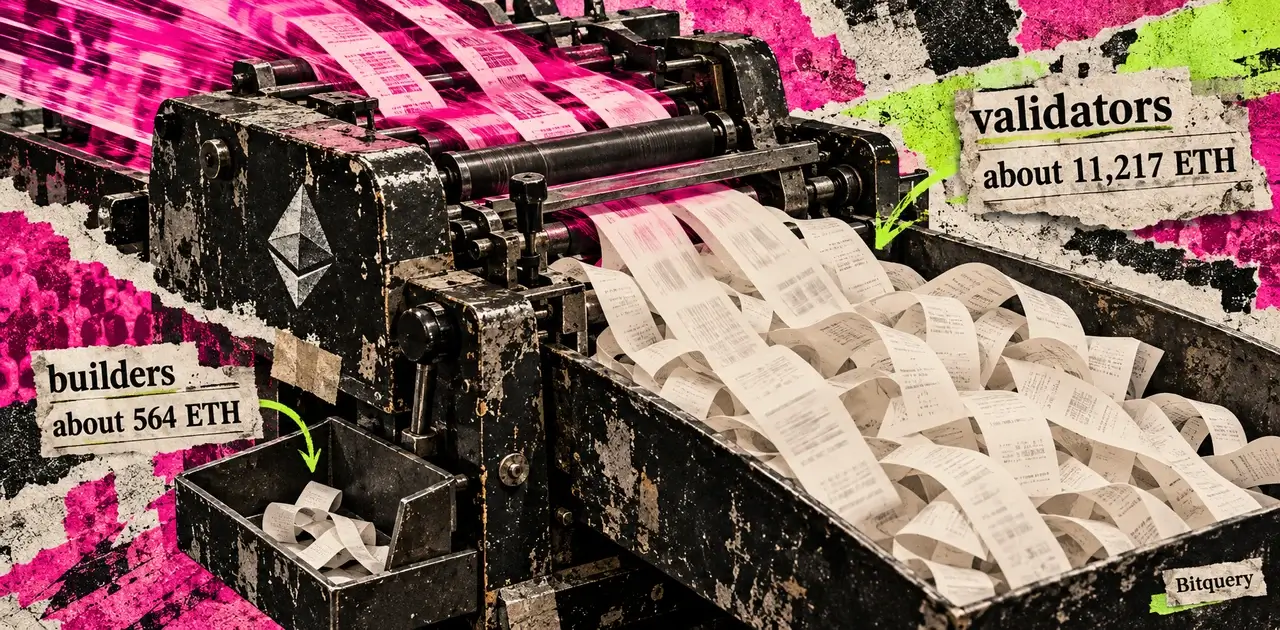
- Bitquery estimates about 11,217 ETH went to proposing validators over roughly four and a half hours.
- Block builders kept only about 564 ETH in the same period.
- CryptoSlate's headline puts validator gains near $30 million.
- The same headline says the hackers lost about $119 million in rushed trades.
- Most of the money went to validators, not builders.
Ethereum validators made roughly $30 million in one afternoon, and the hackers who hit Binance footed the bill. That's according to on-chain analytics firm Bitquery, as reported by CryptoSlate on November 1.
What the data shows
Bitquery estimates about 11,217 ETH reached proposing validators over a window of roughly four and a half hours. Block builders kept far less, around 564 ETH. That's a lopsided split. Validators got the bulk of it.
CryptoSlate's headline also puts the hackers' losses at about $119 million from rushed trades. The material I have doesn't spell out those trades, so I can't tell you which venues or tokens were involved, or how that loss breaks down.
How a rush turns into validator income
Mechanism first. If you need transactions to land fast, you bid up priority fees and pay for placement. Builders compete to assemble the most valuable blocks, and in that contest most of the payment typically gets passed along to the validator proposing the block. Bitquery's numbers fit that pattern.
Why it matters
For stakers, it's a reminder that chaos can pay. A burst of urgent, high-bid activity can push rewards well above normal for whichever validators happen to propose blocks in that window. That's luck as much as skill.
For anyone moving funds in a panic, it's a warning. Rushing is expensive, and the cost lands in someone else's pocket. What's still unanswered is how much of that $119 million loss was fees and how much was simply bad pricing. Bitquery's figures don't settle it on their own.
Source: CryptoSlate
Top Crypto Casinos Right Now
🇺🇸 Showing sites that accept players from United States Change country
Advertising disclosure: we may earn a commission when you join an operator via links on this page, at no cost to you. This never dictates our ratings. How we make money

More info Less info
Why we chose it: A US-facing book that pays a premium for crypto deposits: 125% against 100% for cash, with fee-free deposits across five coins.
- Payout time
- Within 24 hours (crypto)
- KYC
- Required
Restricted countries: Australia, Afghanistan, Bulgaria, Central African Republic, Congo - Brazzaville, Eritrea, France, Guinea-Bissau and 16 more.
More info Less info
Why we chose it: BetNow's casino floor with the biggest match bonus we list. The 200% headline deserves a careful read of the code terms behind it.
- Payout time
- Within 24 hours (crypto)
- KYC
- Required
Restricted countries: Australia, Afghanistan, Bulgaria, Central African Republic, Congo - Brazzaville, Eritrea, France, Guinea-Bissau and 16 more.

More info Less info
Why we chose it: A US-oriented casino that turns away only New Jersey. The cashier takes crypto, but the site publishes fewer specifics than any operator we list.
- KYC
- Required
Restricted countries: New Jersey (US).
Mia Chen
Mia digs into DeFi and on-chain data, translating protocol mechanics into plain English for everyday readers.