
Bitget Hacker Moves $83M in Stolen XRP Beyond Ripple's Reach
A hacker who hit Bitget is shifting millions in stolen XRP, and Ripple lacks the mechanical power to freeze the funds.
Advertising disclosure: we may earn a commission when you join an operator via links on this page, at no cost to you. This never dictates our ratings. How we make money
Key takeaways
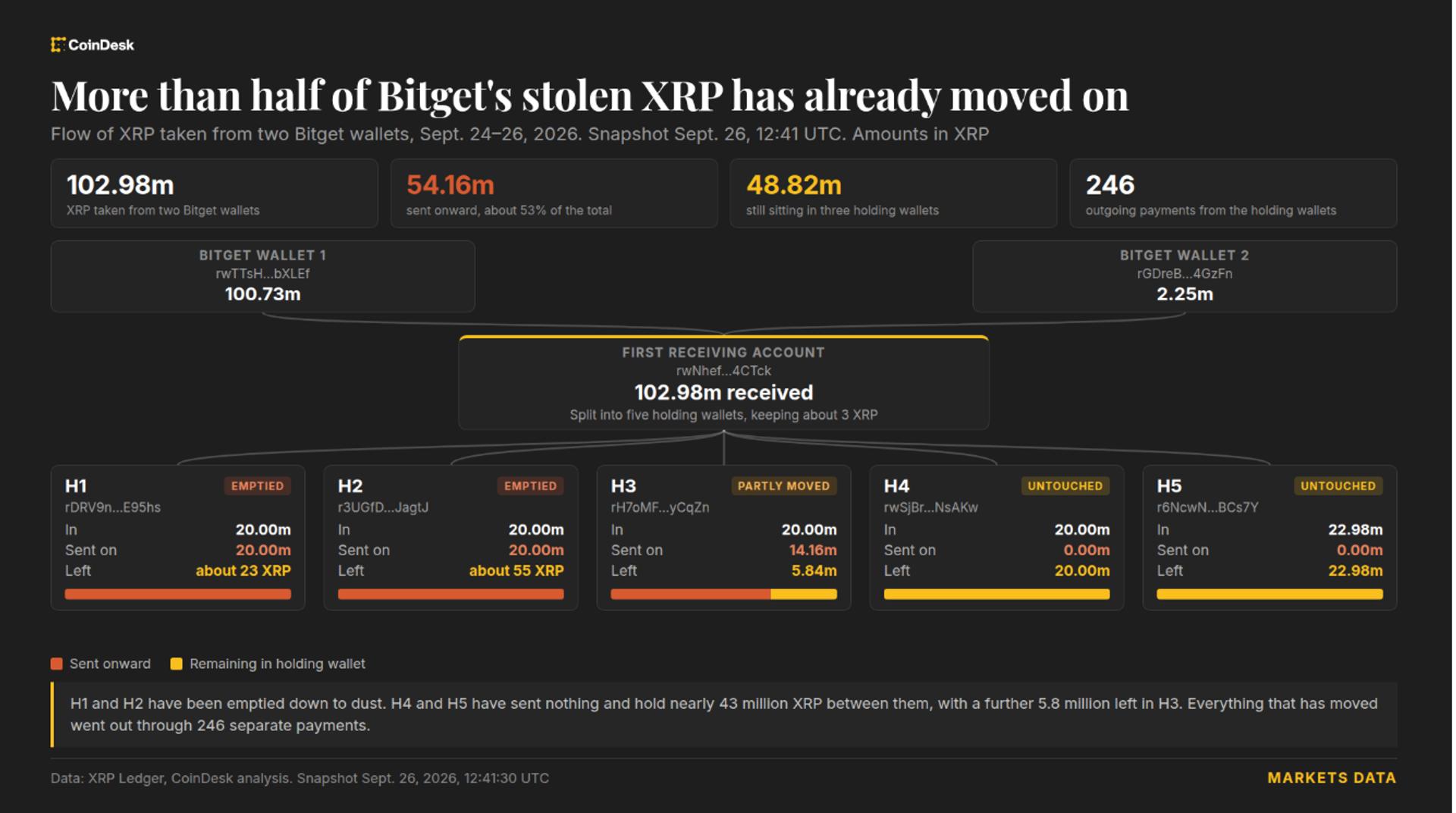
- The Bitget attacker shifted $83 million in stolen XRP across multiple addresses.
- Ripple lacks protocol-level power to freeze native XRP on the ledger.
- Two hacker wallets are nearly empty, while a third is currently being drained.
- Roughly $75 million remains across the original five holding accounts.
The person behind the Bitget breach has begun laundering the loot, shuttling $83 million in stolen XRP across the network. Ripple can't stop them.
On-chain data shows the attacker systematically clearing out five main storage wallets. Two sit almost completely dry. A third is getting drained right now. That leaves roughly $75 million sitting in the initial cluster of accounts, though those tokens won't stay parked for long.
No protocol freeze button
Stablecoin operators like Tether or Circle maintain administrative backdoors to freeze wallet balances on demand. Ripple doesn't. The XRP Ledger processes transfers permissionlessly, meaning once stolen funds leave an exchange, protocol developers lack the technical levers to step in and lock the assets.
Why it matters
This highlights the strict line separating native layer-one assets from centralized tokens. When attackers steal native coins like XRP or Bitcoin, standard blacklisting tools don't work. The only remaining line of defense falls on centralized exchanges, which must flag incoming deposits before the thief can convert the loot to fiat.
Source: CoinDesk
Top Crypto Casinos Right Now
🇳🇱 Showing sites that accept players from Netherlands Change country
Advertising disclosure: we may earn a commission when you join an operator via links on this page, at no cost to you. This never dictates our ratings. How we make money

More info Less info
Why we chose it: A US-facing book that pays a premium for crypto deposits: 125% against 100% for cash, with fee-free deposits across five coins.
- Payout time
- Within 24 hours (crypto)
- KYC
- Required
Restricted countries: Australia, Afghanistan, Bulgaria, Central African Republic, Congo - Brazzaville, Eritrea, France, Guinea-Bissau and 16 more.

More info Less info
Why we chose it: Phemex is a derivatives-first venue for Europe, Asia and Latin America. Good engine, mid-size liquidity, and a blocklist that grew in 2025.
- Online since
- 2019
- Licence
- Seychelles
- KYC
- Required
Restricted countries: United Arab Emirates, Afghanistan, Australia, Belgium, Bermuda, Belarus, Ontario (Canada), China and 18 more.
More info Less info
Why we chose it: BetNow's casino floor with the biggest match bonus we list. The 200% headline deserves a careful read of the code terms behind it.
- Payout time
- Within 24 hours (crypto)
- KYC
- Required
Restricted countries: Australia, Afghanistan, Bulgaria, Central African Republic, Congo - Brazzaville, Eritrea, France, Guinea-Bissau and 16 more.
Daniel Okoro
Daniel tracks crypto regulation and policy across the US, EU and Asia, with a decade in financial journalism.
Related News

Anchorage Exec: AI Will Make Crypto Security a 'Slaughterhouse'

Coinbase's AI Has Blocked $4.7M in Scams. Then One Customer Talked Their Way Past It
Coinbase AI Blocks $4.7M Headed to Deepfake Musk Scam